March 25th, 2008
After many years of golf trips around the world, I’ve come up with a golf trip checklist that makes it easy for me to get ready for each trip and also to minimize the gear I’ve got to lug around, while still making sure I’ve got everything I need. You can download the checklist below to customize it for yourself.
Download the Golf Trip Checklist
Here’s the basic checklist (details given below):
- 4 golf shirts
- 2 non-cotton undershirts
- 1 longsleeve undershirt
- 4 pair golf socks
- 2 underwear (washable)
- 1 underwear (cotton)
- 2 long pants for golf
- 1 or 2 shorts for golf
- 1 Goretex rain suit + golf gear
- 1 Wind vest
- 1 Hind Drylete longsleeve undershirt
- 1 golf shoes
- 1 black long pants
- 1 black belt
- 1 black longsleeve polo shirt
- 2 dark/patterned button-down shirts
- 2 black t-shirts
- 1 white t-shirt
- 1 black “dress” shoes
- 2 pair black socks
- 1 running/tennis shoes
- 1 running shorts
- 1 compression shorts
- 1 exercise t-shirt
- 1 pullover/sweater
- 1 toiletries
- 1 Cottonelle (1.5 per day in ziploc bag)
- 4 contact lenses & solution
- 1 prescription glasses (backup)
- 1 folder w/ tickets/itinerary/passport/etc.
- 1 camera, gear, recharger, batteries
You may see a few odd things on the checklist — like packing only two pair of underwear! — so I’d like to explain those below and give you some of my specific product recommendations.
Checklist Details
One fundamental is that you don’t need to pack “ten of everything” for a ten day trip! Most itineraries will/should have a 2-day stay in the same place at some point, preferrably near the middle of the trip. Use that opportunity to get some of your clothes (shirts, pants, socks, etc.) laundered at the hotel while you’re out playing golf. The other thing is that you can easily wear the same golf shirt a couple of times, especially if you’ve been wearing an undershirt. It just doesn’t get that hot (usually) in Ireland and Scotland and you’re not going to be sweating up a storm.
Golf Shirts — Four golf shirts is enough for any length trip. You can easily wear the same shirt more than once and you can always get them laundered mid trip. Plus, chances are you’ll want to purchase a shirt or two along the way as a momento.
Non-cotton Undershirts — I like to layer for warmth. Wearing an undershirt also extends the “wearabilty” of your golf shirt. The key here is it shouldn’t be cotton. Any of the polyester/spandex blends from REI, Nike, UnderArmour, etc. will work great.
Washable Underwear — Yes, you only need two pair of underwear for the entire trip regardless of how long it is. Not only does this save space, but you won’t have to lug a bunch of dirty underwear around in your suitcase. I would highly recommend the Ex Officio boxer briefs. They come in briefs and boxer styles as well.
Here’s how the “2-Pair of Underwear” system works. After golf, you come back to your hotel and pop into the shower wearing your underwear. While showering (leave your underwear on) soap up and wash yourself and your underwear. Near the end, take ‘em off and rinse well. After drying yourself off, place your just-washed underwear on a dry towel, roll it up, and then stand on the towel to extract as much moisture out of the underwear as you can. Remove from towel and hang over a chair to dry. Get dressed and put on the clean underwear that you washed the night before. Wear that underwear for the evening (while your just-washed pair is drying) and for the next day. Using this system you will always have a clean pair of underwear on hand.
After Golf Clothes — Bring a pair of dark trousers and a couple of nice button-down dress shirts. Don’t wear your golf clothes when you go out for dinner. And leave the jeans at home; they are heavy and bulky. Try your best not to look (and act) like a tourist. :-)
Travel Luggage
I use The Last Bag from Club Glove which is perfect for holding the golf clubs, shoes, rain gear, balls, and extra clothing. It’s also compact once you take everything out and so fits well in the rental car. Do NOT use one of the hardshell cases; they are just too bulky and take up too much space once in country.
My suitcase is from Travelpro, the Platinum 5 22″ Expandable Rollaboard Suiter (suit holder stuff removed). It’s not too big — so I’m not tempted to bring too much — but not too small either.
Share This
* * * *
Rob Babcock
Author/Golfer/The Golf Guide Guy
www.GolfAdventureGuides.com
Posted in Travel |
add to del.icio.us |
digg it!
January 20th, 2008
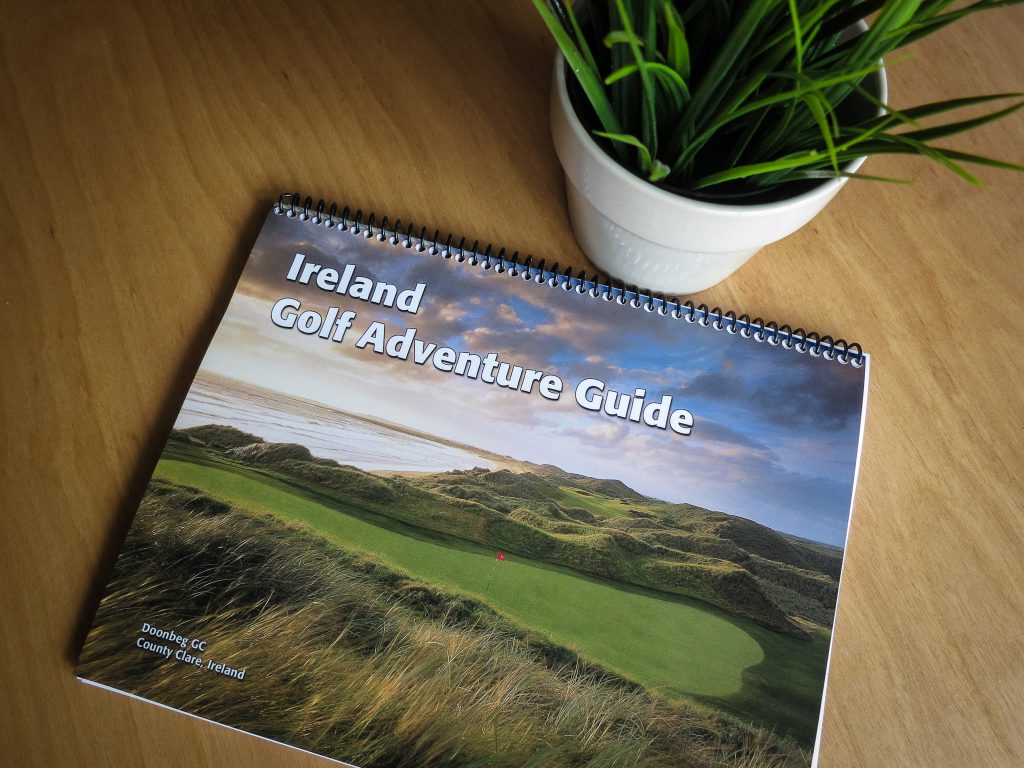
Here’s an example of using the Ireland Golf Adventure Guide to plan a golf trip for four golfers.
The Scenario
Four golfers from New York want to enjoy five days of golf in Ireland this summer.
Using the Ireland Golf Adventure Guide
Here’s how a user of the guide might plan such a trip. The text below is basically describing the thought process and the use of the guide, while working through the trip-planning steps (p. 2) then making reservations and tee times. In this fictitious example, the trip planner is basically thinking out loud. Let’s go!
Buy the Collins Visitors Map Ireland (p. 3). I won’t need the map while planning this simple itinerary, but I’ll want it in Ireland to help navigate the Irish roads. From the PDF version of the guide, I can click on the picture of the map (or its ISBN number) and it takes me right to the web page on Amazon.com where I can buy it. Very convenient.
Start building the rough itinerary (p. 6). We only have five days, so I want to minimize driving. Looking at the Driving Times & Distances map (p. 8) and Golf Courses & Towns Map (p. 9) I see that the southwest area is good. The Getting to Ireland section (pp. 18-19 are relevant to travellers from the U.S.) recommends flying into Shannon. I’ll figure out where to stay later.
Make a list of courses (pp. 7-17). I see that possible courses in this area are: Tralee, Dingle, Dooks, Killarney, Waterville, Ballybunion Old, Doonbeg, Lahinch Old, Old Head, Dromoland, and Adare. That’s enough; we only have five days.
Fine tune the course list. Having previously read about Tralee, Ballybunion, Doonbeg, and Lahinch, those go to the top of my wish list. I need one more course. Since we’re playing Tralee, let’s stay in Tralee after we arrive (p. 28). Old Head is quite a drive, so that’s out. Waterville is a good course, but not that close. I decide against Dromoland and Adare; we want another links course. That leaves Dooks and Dingle. I check out their relative ranking (p. 16) and Dingle comes out ahead. I see that Eddie Hackett did some design work in 1972. I look up Hackett in the Golf Course Designer index (p. 17) and see the other courses he designed. I’m impressed and decide to play Dingle. Our five courses are: Ballybunion Old, Dingle, Doonbeg, Lahinch, Tralee. But that’s just a list, not an itinerary. I need to put them in playing order.
Arrange the courses in sequence (p. 6). Since we’re staying in Tralee, it might be nice to play Tralee the first day so we don’t have to rush in the morning. The Itinerary Tips (p. 6) and Choosing Where to Stay (p. 23) lead me to decide on playing Ballybunion on the way to Lahinch (due to the change of accommodation). That means we should play Dingle on day 2. Ballybunion lands on day 3, and Lahinch and Doonbeg are pretty much interchangeable as the last two days.
Pick when to go. In the When to Go section (page 4) I see the weather is good in June and the golf courses less crowded than in July or August. Lets go in June. I check out the average rainfall and temperature graphic (p. 5) and June looks like a good choice.
Transfer to the calendar (p. 6) Using the Course Cards (card_irl200x.pdf), I see that the only course in this list with visitor-policy issues is Tralee. Looking at the detailed visitor policy (p. 15) for Tralee confirms it–no visitors Sunday (all year) or Wednesday (June, July, August). That means we could play our first round in Tralee on a Monday. Looking at the calendar (calendar_irl2007.pdf) for June, I see that Monday, June 5th is a bank holiday and most likely won’t allow visitors (holidays are treated like Sundays). We want to fly on the weekend, so let’s start the trip with the first day of golf at Tralee on June 12th. I write out the courses on the calendar (I print out just page 6 to save paper) and the arrival and departure dates fall out. From the calendar:
- June 10 — Depart U.S.
- June 11 — Arrive Shannon. Drive to Tralee. Stay in Tralee.
- June 12 — Play Tralee. Stay in Tralee.
- June 13 — Play Dingle. Stay in Tralee.
- June 14 — Play Ballybunion Old. Drive to Lahinch (use Shannon ferry, p. 32). Stay in Lahinch.
- June 15 — Play Doonbeg. Stay in Lahinch.
- June 16 — Play Lahinch Old. Stay in Lahinch.
- June 7 — Drive to airport. Depart Shannon.
Make air travel reservations (pp. 18-19). I now know our desired arrival and departure dates from the planning calendar and use those to book flights. I see (p. 19) that Continental has direct flights between Newark (EWR) and Shannon (SNN). From the PDF version of the guide, I link directly to Continental’s web site and book the flight.
Make the tee times (p. 2). I call the courses myself before 5pm Ireland time, which is noon EST (p. 33), and get the tee times. Alternatively, I could have had SWING (p. 31) do it, but making a tee time in Ireland is really no harder than calling a local course. A few of our courses want fax confirmations and deposits, so I do that with the fax cover page (faxcover_letter.doc) that comes with the guide. Everything has worked out as planned, so we now need places to stay.
Book accommodations. I look up Tralee (p. 28) in the Accommodations section and pick the Grand Hotel because its the least expensive one (I’m frugal). I’m online so I click on the weblink in the guide PDF and check out the hotel’s web site. Looks good to me. I call them up and book two rooms (sharing) for the nights of June 11-13. In Lahinch (p. 26) I go for the Atlantic Hotel. It’s right on the main street in town, which is what we like. I call them up directly and book two rooms for the nights of June 14-16. It’s less than a one-hour drive (p. 8) from Lahinch to Shannon airport so there should be no problem getting there for our Saturday morning (11:20am) departure flight. I book the rooms directly myself; it’s just a lot easier than fussing with web-based systems and when I’m done I know for sure that the reservation has been made.
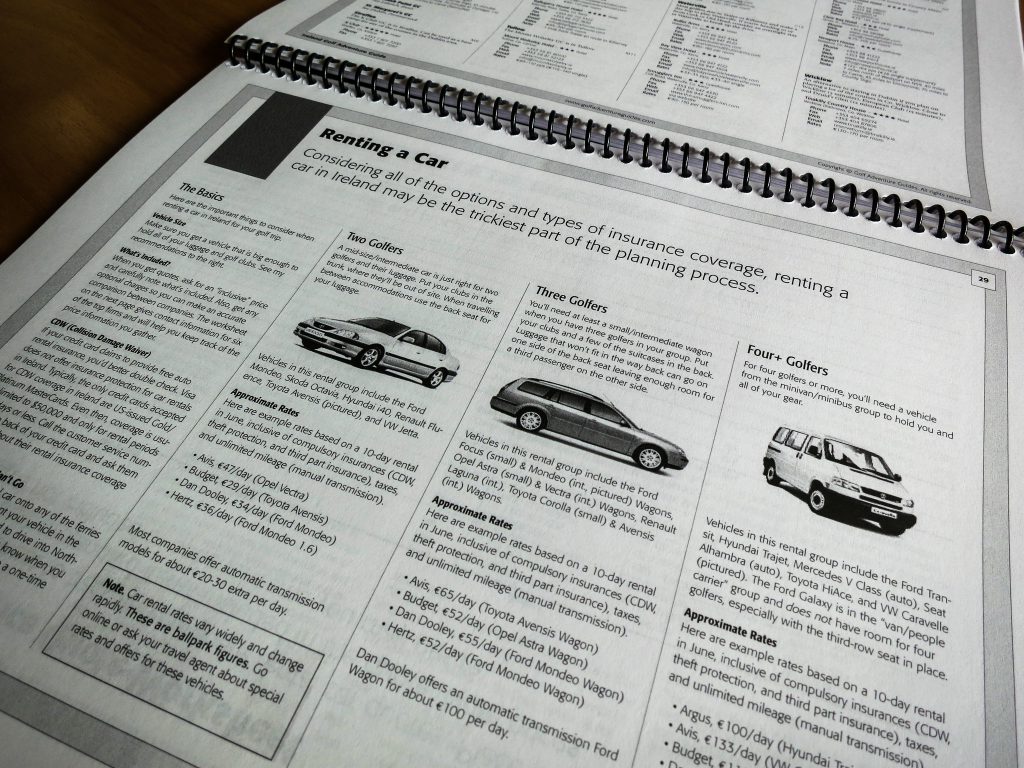
Rent a car. Since there are four golfers, it looks like were going to need a minivan/minibus (p. 29). I normally rent from Avis so I check them out first and get a quote, noting all of the options on the worksheet (p. 30). I then checked out Argus and Dan Dooley for their quotes. After comparing it all, I rented from one of them.
* I could have had my travel agent do this step.
Take the trip. I take along parts of the guide in a clear plastic envelope which also holds the Collins road map. Along the way it can be used to gather score cards, brochures, etc. It’s great that I don’t have to lug around an entire guide book; I just take the pages I need, which is much lighter and more compact. There are some good tips in the Practical Matters section (pp. 32-33) that help me bring the right electrical plug adapter and decide to not bother with travelers checks this time. During the trip, we consult the Golf Courses (pp. 10-15) and Driving Times (p. 8) sections to get directions to the course and determine when to leave the hotel so we arrive at least 30 minutes before our tee time. It’s nice to have all of this information with us.
Estimated Price Per Person
| Airfare |
$609. |
Continental Airlines round trip between Newark and Shannon |
| Green Fees |
$ 220. 85. 195. 240. 200. |
Tralee (€170) Dingle (€65) Ballybunion Old (€150) Doonbeg (€185) Lahinch (€155) |
| Hotel |
$ 234. 253. |
Grand Hotel (Tralee) assuming 60 per person sharing (three nights) Atlantic Hotel (Lahinch) assuming 65 per person sharing (three nights) |
| Rental Car |
210. |
Assuming 7 days at $120 per day split evenly four ways. |
| Total |
$ 2,246. |
Per golfer, not including food, beverages, tips, caddies (June 7-14 2007) |
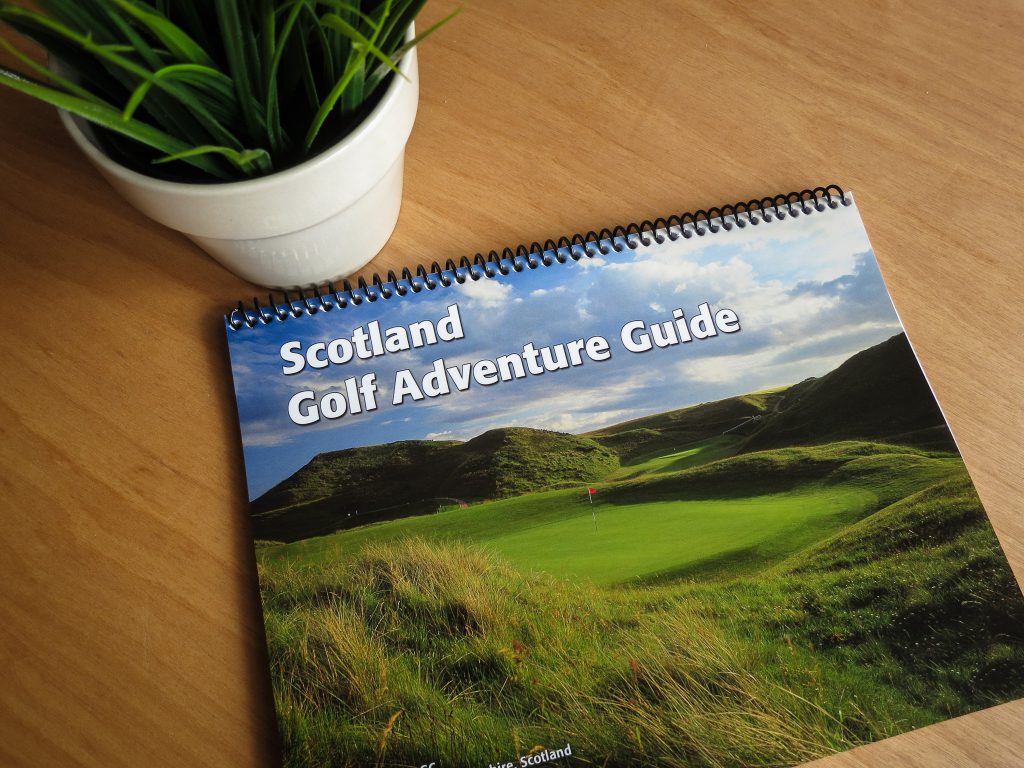
All of the information and tools you’ll need to build a great itinerary for your Ireland (Ireland Golf Adventure Guide) and/or Scotland (Scotland Golf Adventure Guide) golf trips are available from Golf Adventure Guides.
* I didn’t actually contact the courses, hotels, or car rental companies during the writing of this particular example, nor do I normally rent from nor necessarily endorse Avis. This is a hypothetical example.
Share This
* * * *
Rob Babcock
Author/Golfer/The Golf Guide Guy
www.GolfAdventureGuides.com
Posted in Ireland, Travel, Guides |
add to del.icio.us |
digg it!
December 22nd, 2006
This article is from the December 1908 issue of The American Golfer and is “A Critical Description of the Characteristics and Qualities” of St Andrews. Prices and yardages have changed a bit since then.
Golfers who have not been to St. Andrews are often sceptical about the praises they have heard sung to its glorification. They cannot bring themselves to believe entirely that any golfing place is quite so charming or that any course is quite so good architecturally and for the enjoyment that it affords to the capable player as are St. Andrews and its old links. I will consider, then, that at the outset I am abruptly interrogated by my readers on these points, and I answer that I can conceive of the true golfer deriving no greater pleasure than in living awhile in this ancient corner of Fifeshire, and that, provided he knows the game and can play the different shots as they ought to be played, golf on this old course is a supreme intellectual and physical enjoyment. The course has certain minor faults, but the best golfing opinion is generally to the effect that it is superior to any other in Britain.

Well then, what is the charm of St. Andrews? When the golfing man visits it for the first time, and, after a wearisome journey, travels on the last bit of railway from Leuchars function, and presently, feeling the brakes go on, he looks through the windows of his carriage on the seaward side and sees the players driving to some of the homeward holes–the 14th, 15th and 16th–he usually feels something of a thrill, a kind of spiritual ecstacy as of the pilgrim after many wanderings reaching his Mecca at last.
Then in the first brief hours of his sojourn he appears to be inhaling an atmosphere of golf, and to be living in a City of Golf as never before. Here at St. Andrews the industry is golf, the people talk of it and of little besides, largely they live on it, men and boys spend their working hours on the links, there are foundries, warehouses, shops, hotels–all for this game of golf. And in the public places, as if it were to cap this impression of the supreme importance of the game over all other things, the player may see what he will in no other town in the world–official printed notices invested with all the authority of the police and the law stating that golfers are forbidden to play on the course with iron clubs only (for the sake of the tees and the fairway) and that offenders are liable to be fined twenty shillings and costs at the police courts or, in the alternative, to be sent to gaol (jail) for a month! The Corporation is given these powers because the links is town property and for the benefit of the town. It is a matter of interest to add that a little while since a personage of no less importance than the Prime Minister, Mr. Asquith, who is a keen golfer, went out to play at St. Andrews with no wood in his bag and was duly “pulled up” under this law. In the same way, it is a punishable offence to practice putting on the 18th green. These notices are prominently displayed outside the police station, in the post offices, in the hotels and other public places. Mention of such small matters serves to show that St. Andrews is really not at all like other golfing resorts, and visitors to it feel that very soon after their arrival.
Yet it sometimes happens that, after the first day or two, there is some small sense of disappointment, and at this period this may also be the feeling in regard to the quality of the course. The plain fact of the matter is that both need to be known well to be appreciated properly, and it has been almost the invariable experience that people who have cared little or nothing for St. Andrews at the end of their first visit, have liked it better the second time, and that on the third or fourth they have developed a passion for it which has prevented them from keeping away afterwards for more than a few months at a time. They feel that they have found their natural home at last, and life and the game seem stronger things than ever they were before.
This preamble will have done something to give strangers some idea of the charm of St. Andrews as a golfing resort, and how it comes to be what we would call an acquired taste. The strangers are at the outset a little overcome and awestricken by the vast traditions of the place, the knowledge that golf has certainly been played here for about four hundred years, that it was on this old course that the great captains of golf of the ancient days, like St. Clair of Roslin, played their game, and that in later times giants of the game like Allan Robertson and the Morrises, father and son, and–still later–that hero among amateurs, the late Lieut. F. G. Tait, played most and loved most to play. But veneration of this kind is sometimes a fleeting thing, and then the golfer visitor comes to reckon up St. Andrews severely on its golfing merits and in the end is satisfied.
Then in what does the quality of St. Andrews chiefly consist? In the first place, there is not a really bad hole on the course. There may be one or two which are not of great excellence, but in hardly any case can the player take the hole in the par figure, or one less with a long putt, without playing good and proper golf. Above everything, St. Andrews is a course for golfers to think hard when playing it. Every shot has to be considered with the utmost care; and it is especially the case that with tee shots and long seconds the line has to be carefully decided on and then taken almost to a nicety, otherwise, even if a bunker is avoided, the succeeding stroke is rendered enormously difficult. In many respects there seems to be a positively devilish cunning in the course. There is generally an easy and most enticing way of playing the shot in hand, but it happens just as often that if that way is adopted the player has very much extra to do with the next one. Thus, in a general way there is plenty of room on the left when playing from the tee, while the way to the right seems to bristle with hazards and other dangers. The result of this is, as some say, that St. Andrews golfers have come to be a race of pullers; but that is rather a reflection on their capacity. The man who is not sure with his wooden clubs, and cannot command direction as he would like, goes to the left for safety and takes his chance about what he will get for the next shot. But, though the way to the right is so well guarded, there is plenty of room for the accurate player, and if he can get a safe line that way he is well rewarded by an easy passage to the hole afterwards. Thus we have one way for courage and skill and another for fear and lesser ability, and it does not seldom happen that when these elements are opposed to each other the keeper of the latter set is struggling for his half all the time.
These circumstances are brought about partly by the conformation of the ground, which is surely the finest on earth for golfing and seems almost to have been designed by Providence for the purpose, and partly by the judicious manner in which the innumerable pot bunkers have been placed. They have not been put where they now are as the result of the deliberations of a committee during a few months, but as the result of the aggregation of experience of the best players, theorists and critics during generations. And in this matter the course is now appreciably more difficult than it was a few years since. One decade back it was at its easiest, the whins and rough that made trouble in the olden days having been trodden away by thousands and thousands of players. Something had to be done to make up for this, and when the rubber ball came in and absurdly low scores were being made on courses everywhere, the authorities at St. Andrews determined that it was the time for action, and consequently in the winter of 1904-5 a large number of new bunkers were cut. The result was seen in the fact that whereas in 1900 J. H. Taylor won the Open Championship there with a score of 309 for the four rounds done with the gutty ball, in 1905 James Braid took 318 strokes with the rubber ball and even then won the championship with a good margin over the next man. At that time there were many complaints that some of the new bunkers were unfair, that they were hardly to be seen, and that, being sometimes small and deep, they were too difficult to get out of. But time has softened the feelings of resentment against them, and it is realized that they make for judgment and accuracy. The course, as Mr. John Low points out, is not one that tests the exceptionally long driver who carries over everything, so much as the ordinarily long driver. This latter man must place his tee shot, and one of the first things he has to realize is that his proper line is not always the straight one to the hole. Thus, at the 9th hole there is a bunker right in the middle of the course just at the distance of a quite first-class drive. Some say, then, that that is unfair; but the answer of St. Andrews is that the bunker is there to be avoided, and if you are going to drive that distance you must make up your mind which side of the bunker you are going to drive to. It might just be added that the predominant bunker is the small pot. There are a few huge bunkers like the Hades, met with in going to the 14th, but the cross or ribbon bunker, such as is common on many other courses often reckoned in the first-class, is conspicuous by its absence. From this it almost follows that mere carries from the tee, irrespective of direction, are rarities.
These remarks have reference chiefly to the long game; but corresponding difficulties are met with in the short one. To approach the hole properly with an iron club, it is not enough to play a shot well, but the shot must be played, and thoroughly, if the best results are to be achieved. Most of the greens are on plateaus which in itself makes for thought and difficulty: but the feature of the course, so far as the short game is concerned, is that the bunkers protecting the greens are most dreadfully close in–not merely to the green but to the hole itself, sometimes being within four or five yards of it. Having to approach to a plateau green with the knowledge that only about that distance beyond the pin is a wretched little pot is about as much of a test of the nerve and skill of the operating golfer as he need wish for. Knowing his course, what he does in this case, if he can, is to play his previous shot so that he places that aforesaid bunker out of the line of his approach.

Thus in one way and another each shot to a hole bears so very directly on the others as is the case on no other course, and. as Mr. Low puts it, “the playing of the hole thus becomes not a series of isolated shots with no bearing the one on the others, but each stroke has to be played in relation to the following one, and the hole mastered by a preconceived plan of action.” Surely this is not only interesting golf, but good golf in the best sense, and that is why we regard St. Andrews as the supreme test of a player.
And now from the general to the particular, in the way of a glance round the links, making note here and there of special features. After the first hole the course goes round nearly to right angles, and out at the end (here is a long hook on it, and there is a crossing in one place, a circumstance which has sometimes led to accident, as at the autumn meeting last September, when a personage of no less consequence than Mr. A. J. Balfour, the ex-Prime Minister, was struck violently on the head with the ball of another competitor, just as he was about to putt at the second short hole. The line of the course (as will be gathered from the plan that is presented and which will explain many points in the architecture and bunkering) makes it that winds of all kinds have to be encountered. The first hole looks a simple thing, just requiring a cleek or iron for the second at most times; but the Swilcan Burn, out of which it is next to impossible to play and from which the ball is generally lifted under penalty, is close up to the green, and has been the ruination at the outset of hundreds of what would otherwise have been excellent rounds. This hole becomes a particular terror when it is not the 1st but the 19th, as in the case of ties in the matches for the Amateur Championship, and it made a big piece of history, among other occasions, in 1895, when the event mentioned was played at St. Andrews. At that time Mr. John Ball, who had already won the championship four times and was then the holder of the distinction, was just at the height of his powers, and it was his clearest ambition to win the championship once at the traditional Scottish home of the game, which no Englishman had ever done. He ran through to the final, where he met Mr. Leslie Balfour Melville, and this pair tied (the final was then an 18-hole affair) and had to go on to the 19th. Both played short of the Burn with their seconds, and then Mr. Ball, for about the only time in his life in such circumstances, seemed to get scared. He hesitated, and finally determined to use a mashie that he had not had out of his bag for some days. With this stranger he put the ball into the water and lost the championship. It took him twelve years to make up for that mistake, but at last, in 1907, he did win the championship at St. Andrews, and it was a curious coincidence that Mr. Balfour Melville was then the captain of the Royal and Ancient Club and had the pleasure of handing the Cup and gold medal to the hero of the meeting.
The second is a fine two-shot hole, and the tee shot has to be played to the left or to the right according as to whether the wind is for or against. The green is small, and is clustered with bunkers all round so that the second shot has to be a marvel of accuracy. The third hole is a gem of the drive-and-iron class. Here is an instance where a pulled ball gets the player into a dreadful difficulty with his approach. The fourth hole is another two-shotter, and special interest is given to the approach by the fact that there is a knoll sticking up out of the fairway just in front of the green. The fifth is the “long-hole out,” and is a good 5 at any time, though you do sometimes see some of the big hitters like Mr. Edward Blackwell using a mashie for their second when they have a high wind behind them. Mr. Blackwell, who for long has enjoyed the reputation of being the longest driver in the country, here performed, some sixteen years ago, perhaps his most wonderful feat in this department. He reached the green in two shots–with the gutty ball of course–and then, as he and his partner only intended playing a few holes, they turned round and played the same hole in, as it may be done, the course being so laid out that it is sometimes played in the reverse direction. Again he reached the green in two shots, so that whichever way the wind was its effects were balanced, and in four shots the player drove over a thousand yards. The hole here is cut on what is probably the largest green in the world, serving for the thirteenth as well; and if the player’s ball is on the edge of it he has something unusual to do to get dead with his long putt. The other holes going to the turn need not be specially described, though each has its points. The eighth is the first short one, and is not at all difficult unless there is a following wind. St. Andrews has only two short holes, and nowadays in Britain, when new courses are being laid out of a length that satisfies the rubber ball, there is a disposition to include at least three and sometimes four short holes to make up for all the long hitting elsewhere.

The tenth hole is about the weakest on the course. Generally it pays a man to drive short at it, as there is danger ahead unless a perfect line is kept. However, in a round of the Amateur Championship in 1907, Mr. Guy Campbell, one of the best of the young Scottish school, reached the green (312 yards) with his tee shot, though the turf was heavy with rain. Mr. Campbell ought to have won that match if he had had nerve enough, but he hadn’t. The eleventh, or “High” hole, is the short one on the return journey, and a very fine one of its class. The green is up on an eminence at the edge of the River Eden. Be too strong and you go over, and there are yawning bunkers on each side, particularly the famous “Strath” on the right. Here it may be said that most of the bunkers on the course have their special names, usually derived from players of the past who for some reason or other had intimate connection with them. These names are shown on the plan. The twelfth is a drive-and-iron bristling with difficulties, and the thirteenth, or “Hole o’cross,” is a magnificent two-shot hole with the famous hazard known as “Walkinshaw’s grave” to be taken into consideration when playing best to go to the right from the tee, and others to the left, James Braid, the reigning Open Champion, being the second. There are two schools of thought concerning how this hole should be played. Some think it is one of the leaders of the latter party. The fourteenth has the “Hell” hazard among its collection; but it is not such a dreadful thing as its name makes out, and the reverend clergyman of whom it was said that he was left by his partner “repeating the Athanasian creed at the bottom of Hell,” was no doubt a very moderate player. The best players play to the left with their seconds. The fifteenth is a good hole again, and the sixteenth includes the well-known hazard called the “Principal’s Nose.” The worst of this thing is that when you have cleared it you are not always all right, for there is another bunker, rejoicing in the name of Deacon Sime, just beyond. You may play to the left or right, but the passage down the right between the bunker and the railway is exceedingly narrow. At the last Open Championship at St. Andrews, this being in 1905, Braid, who won eventually, was playing his last round and seemed to have the thing at his mercy when his prospects were suddenly placed in danger at this hole. From the tee he drove over the “Principal’s Nose,” but pitched into Deacon Sime, and with his second shot he sent the ball into a perfectly horrible place on the railway, where it was found lying right against one of the metal clamps supporting the rails. The third shot did not dislodge it; but with the fourth he got on to the course again. Eventually he holed out in 6, and in the circumstances it was not at all a bad six. It might have been a dozen.
The seventeenth is perhaps the most famous hole on the course, the “Road hole,” as it is called in consequence of the road running right alongside the green, where it has been the undoing of many a player who felt up to this point that he was winning something. It is a long dog-leg hole, with the black railway sheds and what is called the station-master’s garden beyond them, facing the player from the tee. Long drivers, with the wind helping them, will sometimes go for the sheds, but generally the line is to the left. Thereafter the safe game is to get in to the right again with the second, so that the short approach will be as easy as possible, leaving neither the bunker to be pitched over nor the road to be run on to. If the second shot is pulled, heaven help the man who pulled it, if his match or card is in a precarious state. In 1905, when playing for the championship and having a good chance, Taylor got on to this road (like many another champion before him, and like almost innumerable other competitors at that meeting) and he took an expensive two to get off. This hole of all others in the world is the one that the running-up school of approachers point to as that where pitching is not merely wrong but mostly fatal. Taylor will insist on pitching it, this being his favorite shot, and the hole is running up a pretty big hill of strokes against him in consequence. The last hole, which has just been christened the ”Tom Morris” by special resolution of the Royal and Ancient Club, to perpetuate the memory of the great player who recently passed away, represents a straight and unbunkered journey home.

There we have the round, and it need only be added that the lengths of the various holes when at full stretch are as follows: First, 365 yards ; second, 416; third; 353; fourth, 417; fifth, 533; sixth, 370; seventh, 345; eighth, 164; ninth, 303. Total length out, 3,266. Tenth, 312 ; eleventh, 148 ; twelfth, 318; thirteenth, 413; fourteenth, 516; fifteenth, 405; sixteenth, 338; seventeenth, 456; eighteenth, 361. Total length in, 3,267. Full length, 6,533 yards.
What has been done on the course? Many wonderful scores at different times, as must needs be the case considering the amount of play by men of the first quality that takes place upon it. The first time that anything better than 80 was ever done was in 1858, when old Allan Robertson, who was then forty-three years of age, did a 79. It is to the point to add at once that it is believed that the first time that anything better than 70 has been done on the completely bunkered course, although it was not at full stretch, was only a few weeks ago, when Fred McKenzie, who some two or three years since acted for a little while as professional to an American club, went round in 69. It is to be remarked, however, that nothing is recognized as a record at St. Andrews unless it is done in a stroke competition, which McKenzie’s score was not. The existing and recognized records are, professional, J. H. Taylor, 75, done in 1900 with the gutty ball, and, amateur, Messrs. Norman Hunter and V. A. Pollock, 74. It must be pointed out that the only opportunities the professionals have of making new official records is once every five or six years when the Open Championship comes to be held there, and they have only had one such opportunity since Taylor did his 75, and that was over a much more bebunkered course. On the other hand, all the Royal and Ancient Club’s stroke competitions, of which there are two each year, are good for record making for the amateurs. One of the best day’s work ever done at St. Andrews was in September, 1907, by Andrew Kirkaldy. He did 71 in the morning and 72 in the afternoon, and in the thirty-six holes he had only eight 5’s and had nine 3’s. All the rest were 4’s. In the first round he was out in 34. All this stood for the most perfect golf.
The first time the Open Championship was ever played for at St. Andrews, this being in 1873, it was won by a player whose achievements have been long since forgotten–Tom Kidd. In 1876 it was won there by Bob Martin, who still lives at St. Andrews and will carry clubs for you there. In 1879, the more celebrated Jamie Anderson Avon, and three years later the equally celebrated Bob Ferguson, who, many declare, was a veritable Vardon when at his best, was the conqueror. A curious coincidence in regard to these two latter championships is that when Anderson and Ferguson won at St. Andrews it made the third successive win for each man in the championship, and these are the only men who have won it three times running since the Morrises did so and the championship was reorganized.
In 1885 Bob Martin won again, Jack Burns did so in 1888, and the late Hugh Kirkaldy in 1891. So far the event had taken place here at headquarters, as we sometimes call it, every three years, alternating with Musselburgh and Prestwick; but afterwards changes in the system were made, Muirfield was substituted for Musselburgh, and Hoylake and Sandwich crept into the rota. J. H. Taylor won in 1895 and again in 1900, and James Braid in 1905, this completing the list. As for the Amateur Championship, it has been played here six times, beginning in 1886 with the first Amateur Championship of all, and ending for the time being in 1907. Mr. Horace Hutchinson was the first winner, Mr. J. E. Laidlay in 1889 the second, the same player the third in 1891, Mr. Leslie Balfour Melville the fourth in 1895, Mr. H. H. Hilton the fifth in 1901, and Mr. John Ball the sixth in 1907. There has been a disposition on the part of the authorities in the past not to encourage the ladies to hold their championship here, and this was the chief reason why they did not do so until this present year of 1908. They had a good meeting then, but they were not given the freedom of the Royal and Ancient Clubhouse, as some of them seemed to expect they should be! Miss E. M. Titterton of Musselburgh was the winner. It is perhaps as well to add that there is no connection whatever in management between the two men’s championships and the ladies’ affair.
It is fairly generally known that at St. Andrews, on this famous old course, golf is free, and anyone can play there for nothing, whether he or she knows the game or not! That is rather the pity of it, and at the present time there is an agitation to impose a tariff, and so keep the legions of absolutely hopeless duffers off the course. They are spoiling St. Andrews. At present the course belongs to the town and it is supported partly by the town authorities and partly by the Royal and Ancient Club, whose clubhouse, which cost £1,967, overlooks the first tee and eighteenth green. To this, the premier, club, it at one time belonged absolutely, but only for a little while, and it came into the possession of the town by special Act of Parliament in 1894. The premier club, of which King Edward was once captain, has done much for golf in the country generally and very particularly in its own home. It includes the cream of British golfers in its 850 members, which number is exclusive of life members and those living abroad. The entrance fee is £20 and the subscription £3, and it is not easy for an unknown golfer to become a member. There are many other golf clubs of a quite minor character in St. Andrews. The chief of them is the New Club; but as none of them have influence or belong to the course in the sense that the Royal and Ancient does, their names need not be specified.
There are two other courses here. One is called the new course, to distinguish it from the old one, and is a first-class seaside links in every respect, and the other is what is known as the Jubilee course, not nearly so good. There is some talk of making another. But when you speak of golf at St. Andrews you refer only to the grand old course which we have made some attempt to describe.
I have been asked to mention the number of bunkers at each hole on the course. In endeavoring to do so it has to be borne in mind that sometimes two holes run so close together that the same bunker catches a bad shot at each, although in one of the cases it may need to be an exceptionally bad shot, the bunker not being really meant to interfere with the play at that hole. Also there are hazards of other kinds than mere bunkers: and, again, nests of two, three and even more pots all put close together constitute virtually one big bunker. However, in making a census of the St. Andrews bunkers we must count them separately, and, having all these points in mind, we reckon that at each hole there are bunkers as follows: First, 3 (including the burn) ; second, 9; third, 6; fourth, 8; fifth, 8; sixth, 5 ; seventh, 3 (”including the Eden) ; eighth, 4; ninth, 4; tenth, 7; eleventh, 3 (including the Eden); twelfth, 6; thirteenth, 8; fourteenth, 7; fifteenth, 7; sixteenth, 5; seventeenth, 5 (including the road) ; eighteenth, 2 (including the road). But if the player wanders far from his proper line he may find these figures increased. It may be mentioned incidentally that neither the railway nor the fields beyond are out of bounds.
This article is from the December 1908 issue of The American Golfer and is “A Critical Description of the Charicteristics and Qualities” of St. Andrews. Up-to-date information and advice for planning a modern-day trip to Scotland and St Andrews can be found in the Scotland Golf Adventure Guide.
Share This
* * * *
Rob Babcock
Author/Golfer/The Golf Guide Guy
www.GolfAdventureGuides.com
Posted in Scotland |
add to del.icio.us |
digg it!